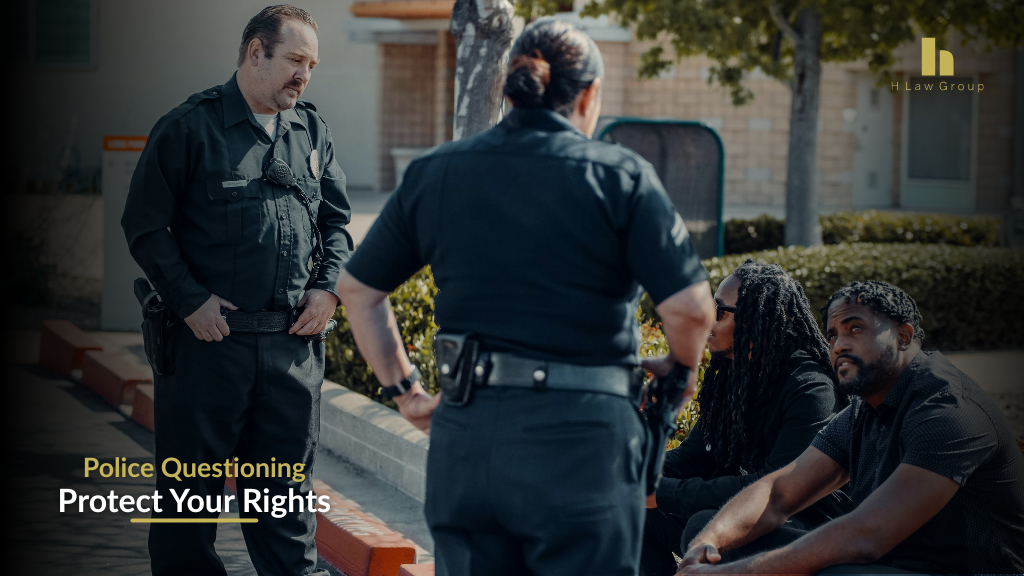

When Los Angeles Police Department (LAPD) or Los Angeles County Sheriff's Department (LASD) officers initiate an investigation, knowing what to say - and more importantly, what not to say - can significantly impact the outcome of your case. Understanding your constitutional rights during police interactions is not just advisable; it's essential.
The Fifth Amendment to the United States Constitution provides that no person "shall be compelled in any criminal case to be a witness against himself." This fundamental protection forms the foundation of your right to remain silent during police questioning.
In the landmark 1966 case Miranda v. Arizona, 384 U.S. 436, the Supreme Court ruled that law enforcement must inform individuals in custody of their constitutional rights before conducting custodial interrogation. The Court held that because of the coercive nature of custodial interrogation by police, no confession could be admissible under the Fifth Amendment self-incrimination clause and Sixth Amendment right to an attorney unless a suspect has been made aware of his rights and the suspect has then waived them.
The Miranda warning is a type of notification customarily given by police to criminal suspects in police custody advising them of their right to silence and protection from self-incrimination. The standard Miranda warning includes:
It's crucial to understand that LAPD and LASD officers are only required to read Miranda rights under specific circumstances. Miranda warnings are required for custodial interrogation, meaning when the individual is in police custody and being interrogated.
This means officers do not need to read you your rights when:
However, once you are in custody and officers begin asking questions that could elicit incriminating responses, they must provide Miranda warnings.
When stopped or detained by police, you are generally required to provide basic identifying information such as your name, address, and date of birth. Under California law, refusing to provide this information can result in additional charges.
However, providing identification is different from answering questions about suspected criminal activity. You can provide your identification while still invoking your right to remain silent regarding the substance of the investigation.
If you wish to exercise your constitutional rights, you must do so clearly and unambiguously. Once a warned suspect asserts his right to silence and requests counsel, the police must scrupulously respect his assertion of right.
Effective statements include:
According to Berghuis v. Thompkins (2010), a suspect must unambiguously invoke the right to remain silent or counsel. Simply remaining silent without explicitly invoking your rights may not be sufficient protection.
If the suspect indicates he wishes the assistance of counsel during interrogation, questioning must cease until he has counsel. Once you request an attorney, officers must stop the interrogation. They cannot reinitiate questioning unless you voluntarily reopen communication or your attorney is present.
While you have the right to remain silent, you do not have the right to lie to police officers. Under California Penal Code Section 148.5 PC, it is a misdemeanor to knowingly make a false report of a crime to law enforcement.
California Penal Code § 148.5 PC makes it a misdemeanor to willfully make a false report of a crime to any peace officer, prosecutor, or grand jury when the person knows the information being reported is false.
To secure a conviction under PC 148.5, prosecutors must prove:
Penalties for violating PC 148.5 include:
Important distinction: This law applies only when you know the report is false. If you genuinely believed the information was accurate based on what you knew at the time, you cannot be convicted under this statute.
Many individuals believe that explaining their side of the story will clear up misunderstandings. However, this approach frequently backfires. Police investigations are designed to gather evidence, and officers are trained in interrogation techniques that can:
Even truthful statements can be misconstrued or used in ways you didn't anticipate. What seems like an innocent explanation can become incriminating evidence when combined with other information officers have gathered.
Officers may request permission to search your vehicle, residence, or person. You have the right to refuse consent to searches. Simply state: "I do not consent to any searches." This does not prevent officers from conducting searches if they have probable cause or a warrant, but it protects your Fourth Amendment rights and may provide grounds for suppression of evidence if the search was conducted improperly.
While you have the right to remain silent and refuse consent to searches, you should never physically resist arrest or obstruct officers in their duties. Under California Penal Code Section 148(a)(1), resisting, delaying, or obstructing a peace officer in the performance of their duties is a misdemeanor punishable by up to one year in county jail and fines up to $1,000.
Even if you believe the arrest is unlawful, the appropriate response is to comply peacefully and challenge the legality through proper legal channels with an attorney.

The LAPD serves the City of Los Angeles and operates under the oversight of the Los Angeles Police Commission and the Office of the Inspector General. The Los Angeles County Sheriff's Department is overseen by two oversight bodies: The Office of the Inspector General (OIG) and The Los Angeles County Sheriff Civilian Oversight Commission (COC).
The LAPD maintains jurisdiction over the 503 square miles of the City of Los Angeles, handling municipal law enforcement matters within city boundaries.
The LASD has broader jurisdiction, serving unincorporated areas of Los Angeles County and providing contract law enforcement services to 42 cities within the county. LASD also operates the county jail system and provides courthouse security.
Whether you're dealing with LAPD or LASD, your constitutional rights remain the same. However, understanding which agency has jurisdiction can be important for:
Both agencies are subject to California law and federal constitutional protections, including Miranda rights, Fourth Amendment search and seizure protections, and Fifth Amendment rights against self-incrimination.
During a traffic stop:
If police come to your home:
If you are arrested:
Sometimes officers detain individuals for investigation without making a formal arrest. In these situations:
Minors have the same constitutional rights as adults. However, additional protections apply. In California, when juveniles are taken into custody, officers should make reasonable efforts to notify parents or guardians. A juvenile defendant's request for their probation officer was not a per se invocation of their Fifth Amendment rights under Miranda (Fare v. Michael C., 442 U.S. 707).
Parents should ensure their children understand:
If you do not speak English fluently, you have the right to an interpreter. Do not allow officers to use family members or bystanders as interpreters for legal matters. Miranda warnings must be given in a language you understand, and you have the right to an interpreter during questioning.
Individuals experiencing mental health crises retain their constitutional rights. However, special protocols may apply. California Welfare and Institutions Code Section 5150 allows officers to place individuals on involuntary psychiatric holds if they are a danger to themselves or others. Even in these situations, statements made during a mental health crisis can potentially be used against you, making legal representation especially important.
A waiver of Miranda rights can be express or implied. If the suspect receives and understands the Miranda warnings and then voluntarily makes statements, those statements may be treated as establishing an implied waiver of those rights.
This means that after being read your rights, if you begin answering questions, prosecutors may argue you implicitly waived your rights. This is why it's critical to clearly and explicitly invoke your rights if you choose to exercise them.
Officers are not required to inform you how your statements will be used. Innocent-sounding admissions can become critical evidence. For example:
Under New York v. Quarles (1984), officers may ask questions without providing Miranda warnings if there is an immediate threat to public safety. For example, if officers arrest an armed suspect, they may ask about the weapon's location before reading Miranda rights.
Officers can ask basic biographical information during the booking process without providing Miranda warnings. These questions typically include name, address, date of birth, and similar identifying information.
Voluntary statements made without police interrogation may be admissible even without Miranda warnings. A "spontaneous" statement made by a defendant while in custody, even though the defendant has not been given the Miranda warnings or has invoked the right to counsel and a lawyer is not yet present, is admissible in evidence (Rhode Island v. Innis, 446 U.S. 291).
This is another reason why maintaining silence is crucial - even statements you believe are helping your case can be used against you.
If officers fail to provide Miranda warnings before custodial interrogation, any statements made may be suppressed. When law enforcement improperly Mirandizes a suspect before custodial interrogation, they consider any statements obtained directly from that interrogation as compelled and illegally obtained.
However, suppression of statements doesn't automatically result in dismissal of charges. Prosecutors may still proceed with other evidence. The impact of suppression depends on:
Confessions obtained through coercion, threats, or promises are inadmissible regardless of whether Miranda warnings were given. California law prohibits the use of any statement obtained through force, violence, or intimidation.
When counsel is requested, interrogation must cease, and officials may not reinitiate interrogation without counsel present, regardless of whether the accused has consulted with their attorney (Minnick v. Mississippi, 1990).
If you invoke your right to counsel and officers continue questioning, any subsequent statements may be suppressed.
Criminal investigations are complex legal proceedings where even innocent individuals can become entangled in serious charges. An experienced criminal defense attorney can:
The answer is simple: immediately. Whether you're the subject of an investigation, have been contacted by police for questioning, or have been arrested, contacting an attorney should be your first priority.
Do not wait until charges are filed. An attorney can often intervene during the investigation phase to:
When facing an LAPD or LASD investigation, seek an attorney who:
Even truthful statements can be problematic. Memory is imperfect, and small inconsistencies can make you appear dishonest. Additionally, you may not know all the facts officers are investigating, and your innocent statements could inadvertently provide evidence for a crime you didn't commit.
This is false. The Court recognized that "other fully effective means" could be devised to convey the right to remain silent, but it was firm that the prosecution was not permitted to show that an unwarned suspect knew of his rights in some manner. Requesting an attorney is exercising a constitutional right, and prosecutors cannot comment on your decision to invoke your rights to suggest guilt.
In California, conversations can generally be recorded if one party consents. This means officers can record conversations without informing you. Assume any conversation with police - whether in person, on the phone, in a patrol car, or in a holding cell - is being recorded.
Miranda violations result in suppression of statements, not automatic dismissal of charges. If prosecutors have sufficient evidence beyond your statements, the case can proceed.
Your constitutional rights during LAPD and LASD investigations are fundamental protections that have been established through decades of Supreme Court precedent. Understanding these rights - and knowing when and how to exercise them - can be the difference between a case being dismissed and a wrongful conviction.
The most important principles to remember:
While these guidelines provide general information about your rights, every case involves unique circumstances that require professional legal analysis. If you are involved in a police investigation - whether as a suspect, witness, or person of interest - consult with a qualified criminal defense attorney who can evaluate your specific situation and protect your constitutional rights.
This article is for informational purposes only and does not constitute legal advice. Laws can change, and readers should always consult a qualified attorney regarding their specific situation.Last updated November 2025. Reviewed by legal professionals at The H Law Group.

No. The Fifth Amendment gives you the right to remain silent during any police investigation. You should clearly state "I am invoking my right to remain silent" and "I want to speak with an attorney." You are required to provide basic identifying information (name, address, date of birth), but you do not have to answer questions about the investigation itself.
Yes, in certain situations. Officers only need to provide Miranda warnings during custodial interrogation - when you're in custody and being questioned. They can ask questions during traffic stops, at crime scenes, or in other non-custodial situations without reading your rights. However, you still have the right to remain silent in these situations.
No. You have the right to refuse consent to searches under the Fourth Amendment. Clearly state: "I do not consent to any searches." Police can still search if they have probable cause or a valid warrant, but your refusal to consent protects your rights and may provide grounds for evidence suppression if the search was improper.
Detention is a temporary stop where police have reasonable suspicion that you're involved in criminal activity. You're not free to leave, but you're not formally arrested. An arrest occurs when police have probable cause to believe you committed a crime and take you into custody. In both situations, you have the right to remain silent and request an attorney.
No. Requesting an attorney is exercising a constitutional right, and prosecutors cannot legally comment on your decision to invoke your rights to suggest guilt. The U.S. Supreme Court has established that invoking your right to counsel is a fundamental protection, not evidence of wrongdoing.